

The story.
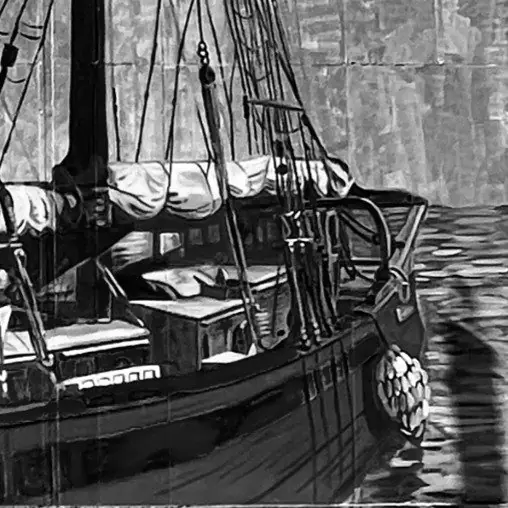
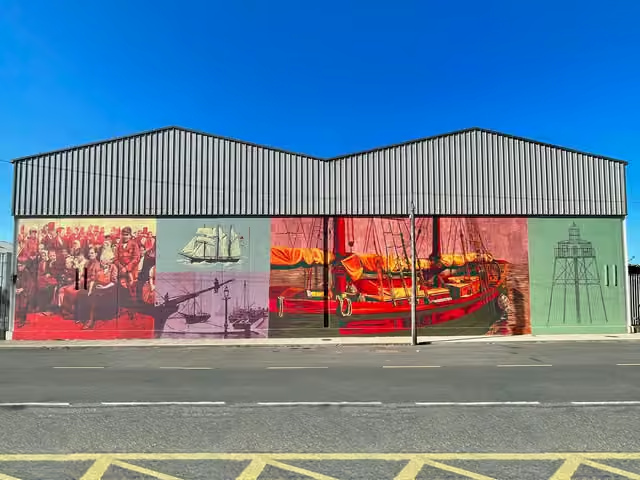
The festival’s research identifies the vessel behind Milu Correch’s mural as The Irish Girl, a three-masted schooner launched at John Connick’s Dundalk shipyard in 1876. Its account describes an occasion marked by crowds, decorated shipping and salutes from steamers.
The mural gives this industrial event a human and imaginative presence. It can be read as a tribute to the builders, crews and families whose lives were connected to the quays. The named vessel and launch details come from the festival account; the artwork’s atmosphere is the artist’s interpretation, rather than a literal documentary image of the ceremony.
The concept of this mural revolves around our rich maritime history and the story of ‘The Irish Girl’ ship built in Dundalk.
This stunning 3 masted schooner was built in the shipyard of Mr. John Connick, one of the most prominent and prosperous shipping entrepreneurs of this era. He was successful in building and launching an impressive fleet of ships from Dundalk, including ‘The Irish Girl’ which was launched amid much fanfare on July 21st 1876.
On the morning of the festivities bunting was decked along The Quay, and all the ships in the harbour were decorated with flags. The ship was christened amid the hearty cheers of a large crowd of people gathered when at 10.30am Mrs. Connick dashed a bottle of brandy on the vessel, and steamers of the Dundalk & Newry Steam Packet Company fired salutes.
Then ‘The Irish Girl’ glided gracefully into the river amidst the enthusiastic cheers of spectators.
The 1800s were a thriving period for the port of Dundalk, with the quays a hive of activity and it could be described as a self-contained town within a town due to the influx of people and trade. There was a harbour office, police station, army barracks, railway station and provision stores. There were also a proliferation of bars and hostelries to quench the thirst of local workers as well as seafarers from visiting ships.
It became a vibrant centre of trade and commerce for Dundalk, creating huge employment in the sail making, shipbuilding and repair yards, coal and timber yards, and the vast import and export of goods including, livestock, linen, tobacco, beer, butter, bacon, and eggs to name but a few!
The hustle and bustle at the quay was a sight to behold as Dundalk Port was also the gateway for emigrants travelling to the new world via weekly sailings to the ports of Liverpool and Glasgow, at a cost of around 8 shillings.
This mural is dedicated to ‘The Irish Girl’, who after 38 years of service was shipwrecked, with no loss of life, in a storm off Bantry Bay. It is also a tribute to the proud memory of our great shipbuilding tradition, our port and it’s people – gone but not forgotten with the passage of time!
Learn more