

Evidence of a lost expedition.
McClintock’s Fox expedition returned in 1859 with evidence about the fate of Franklin’s missing expedition. This included a written record found by Lieutenant William Hobson on King William Island, physical remains and information gathered from Inuit people. McClintock’s published voyage narrative made the findings widely known.
The distinction matters: the expedition did not discover the wrecks of Erebus and Terror in 1859, as the older festival copy suggested. The revised account here follows the Dictionary of Irish Biography. It also corrects the knighthood to 1860, during Queen Victoria’s reign.
The full story of The Arctic Fox IN PUBLISHED WORDS / 1859The Voyage of the “Fox” in the Arctic SeasFrancis Leopold McClintockMcClintock’s published expedition account, documented in the biographical bibliography.
Learn moreLearn more about the subject 2
- Francis Leopold McClintock: expedition and knighthood Royal Irish Academy · Dictionary of Irish Biography
- McClintock expedition journals and correspondence Royal Museums Greenwich
Historical context and editorial interpretation are distinguished above. Sources researched October 2026.
The story behind the wall.
Francis Leopold McClintock was born at 1 Seatown Place, Dundalk, in 1819. He joined the Royal Navy in 1831 and became an Arctic explorer known for his skill in long-distance sledge travel.
Lady Franklin commissioned the Fox expedition to investigate the disappearance of her husband’s ships. In 1859 McClintock and his colleagues brought back documentary and physical evidence of the expedition’s fate, alongside information obtained from Inuit people. Lieutenant William Hobson found the crucial written record on King William Island.
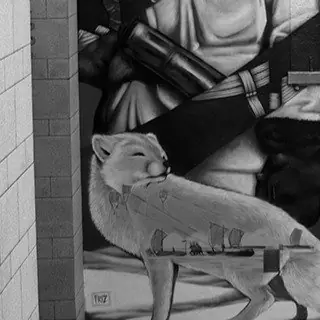
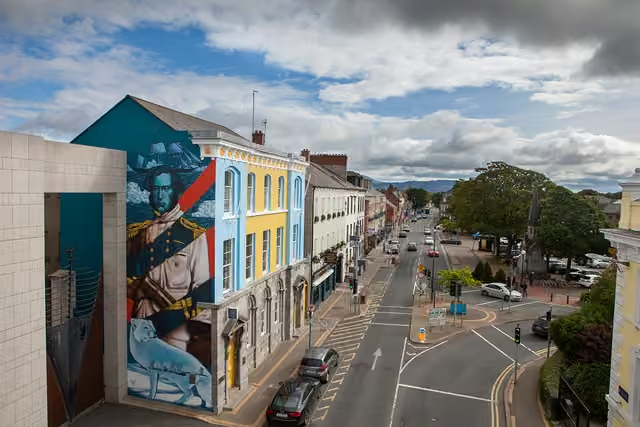
McClintock published The Voyage of the “Fox” in the Arctic Seas in 1859. He was knighted in 1860 and died in London in 1907. Friz’s animal portrait links the Fox and McClintock’s story with his Dundalk birthplace.
Meet Friz.
View artist profile & all their workSligo native Friz is a visual artist based in Bangor, Co. Down. She works in both digital and traditional mediums, using a combination of aerosols and acrylics depending on the surface she is using at the time.
Her work explores history, myths and the folklore that shapes the cultural identity of a place. Using these stories to create a journey of discovery for people as they reconnect with some of their earliest and formative memories. The medium of murals allow these stories to be presented as part of the fabric of the place to new generations and told in a contemporary way.
As a female artist her work leans towards presenting powerful female characters. By juxtaposing with fierce predatory animals she portrays femininity through an alternative lens and explores our connection with the natural world. Sometimes it is a mirror, sometimes an aspiration.