

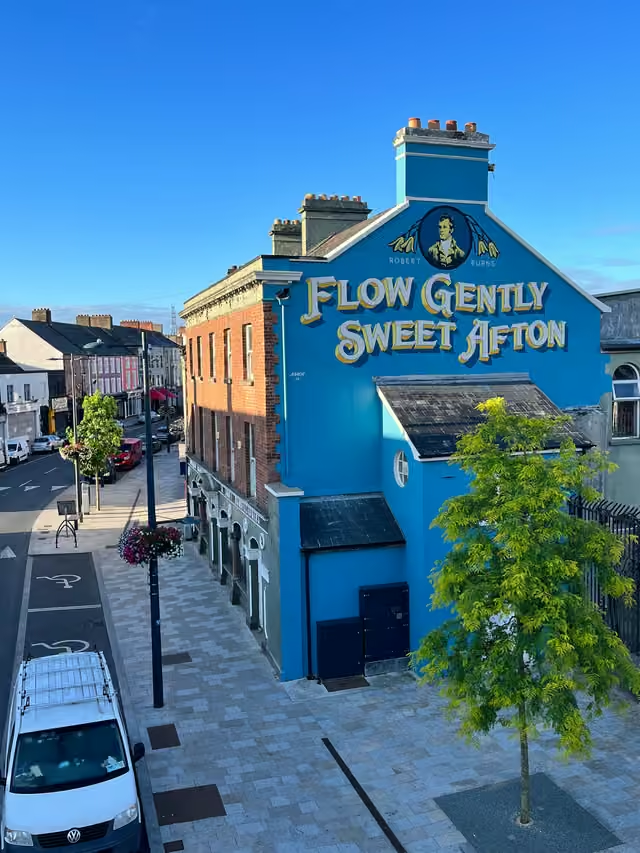
The story.

Image source & credit · Resized for display.
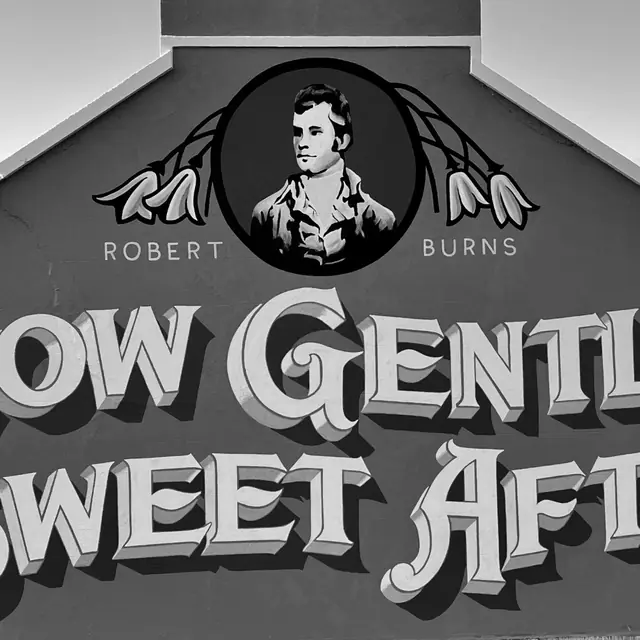
Robert Burns’ Afton Water, often called Sweet Afton, asks a river and its surrounding birds to leave the sleeping Mary undisturbed. The Scottish Poetry Library publishes the poem, whose gentle landscape offers a different kind of subject for a town-centre mural.
The Dundalk connection is familial: the festival’s account places Burns’ sister Agnes near the town and records her burial at St Nicholas’ Church. Mack Signs’ lettering turns a wall into a place to read as well as look, joining Scottish verse with local remembrance.
The Sweet Afton poem was written by Scottish Bard Robert Burns in 1791, and was originally penned as a song, as Burns was mainly a songwriter composing well known pieces such as Auld Lang Syne, Red Red Rose and Wild Mountain Side.
His association with Dundalk stems from the fact that his older sister Agnes is buried in St. Nicholas Church of Ireland graveyard (adjacent to this mural).
Agnes moved to Knockbridge, 6km outside Dundalk, with her husband William Gault in 1817 as he had become employed as the land manager for Matthew Fortescue of Stephenstown House, and also oversaw the construction of Stephenstown Pond. He and Agnes lived many happy years together in their cottage adjacent to the pond, “Agnes Burns Cottage” still stands there today.
A memorial to her brother Robert stands at the front of the graveyard in which she is buried. It was erected by the people of Dundalk in appreciation of his poetry. Agnes is buried in the south-east corner of the graveyard near Yorke Street.
The mural is situated on the gable end of the former PJ Carroll & Company tobacco factory which was established in 1824. This Dundalk company expanded quickly with production facilities in Newry, Liverpool and Glasgow. PJ Carroll himself stipulated that whatever the location of the plant, the manager had to be from Dundalk, born and bred.
In 1919 the company were developing a new product to increase sales for the Scottish market and were struggling to come up with a name. Upon looking across the street inspiration looked back at them in the form of the memorial to the Scottish bard Robbert Burns. They chose his famous poem "Sweet Afton" as the brand name for the new product, and the rest is history.
There is a permanent exhibition in the Louth County Museum tracing the history of Dundalk’s tobacco industry.
Did you know: Tobacco was grown at Smarmore House just outside Ardee in the early 1900's.
Learn more