

A local tradition, renewed in colour.
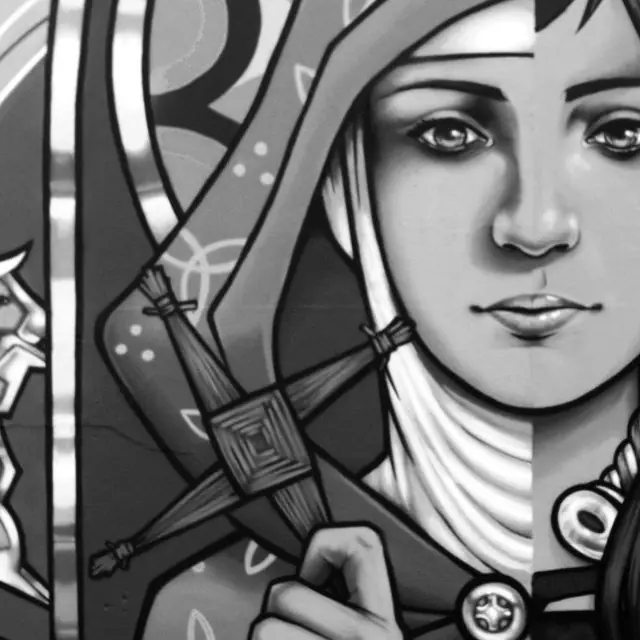
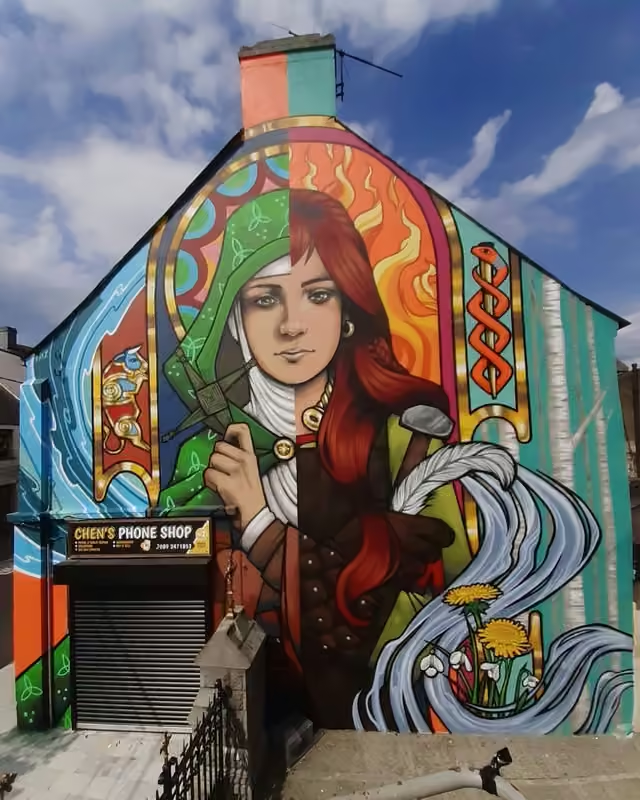
Friz’s 2020 mural draws on Brigid as both Christian saint and pre-Christian goddess. The Brigid of Faughart group, which took part in developing the work, explicitly describes that combination in its own account of the mural.
The association with nearby Faughart belongs to Brigid’s religious and local traditions. Rather than treating every detail of those traditions as a verified biography, the mural brings their values and imagery into the present: care for living things, creativity and the turning of the seasons. Its Bridge Street setting makes that conversation part of everyday Dundalk.
The full story of Brigid of Faughart Learn moreLearn more about the subject 2
- Brigid of Faughart Mural: collaborators’ account Brigid of Faughart
- Brigid of Faughart: festival account EPSO
Historical context and editorial interpretation are distinguished above. Sources researched October 2026.
The story behind the wall.
Brigid of Faughart, Goddess and Saint.
Brigid has been a central part of the spiritual landscape and story of Ireland from the megalithic era, through Celtic times into the coming of Christianity. This powerful mural perfectly illustrates the two aspects of Brigid, Celtic Goddess of poetry, fertility, healing and smithwork: and in Christian history she was an abbess and saint!
She was born at sunrise on the 1st of February in Faughart in County Louth - the beginning of spring and the start of the Celtic festival of Imbolc - it is said she breathes life into the mouth of dead winter.
Brigid had a great appreciation for nature and a deep respect for all creation, she grew up looking after the animals and tending the land on her father’s farm in Faughart.
Brigid was kind and compassionate, she could not bear to see anyone go cold or hungry. From an early age Brigid had absolute trust in the power of the Divine to provide solutions for all those in need.
She shared her goods generously with the poor, often to the dismay of her father as she gave away his choice cuts of meat, prized possessions and even his jewelled sword.
Brigid went to the King of Leinster to seek land on which to build a monastery, he refused. Undeterred she instead asked him if he would give her as much land as her cloak will cover?
The King was amused as her cloak was so small it could only cover a tiny piece of land, so he agreed and Brigid laid her cloak on the ground. She asked her four friends to each hold a corner of the cloak and walk in opposite directions to the north, south, east and west.
To everyone’s amazement the cloak grew and grew and grew, until it covered many acres of land. The King fell to his knees astonished at the miracle he had just witnessed, and realising that Brigid was truly blessed so he granted her the land that she requested.
The spiritual energy that Brigid holds represents many things to the people of Ireland and throughout the world. Her essence transcends time and place as she gathers all under her mantle.
Brigid is still honoured to this day, especially in Faughart, her birthplace, and Kildare, where she founded her monastery. Saint Brigid’s Day (Lá Fhéile Bríde in Irish) is celebrated each year on February 1st, this also heralds the start of the season of Imbolc which celebrates the return of light and growth on earth.
In 2022 Brigid continues to be an important role model and force of nature, inspiring thousands to visit her shine and reconnect with the energy that she embodies at Faughart.
From next year onwards a new public holiday will be created to commemorate Brigid, it will be held annually on the first Monday in February.
Meet Friz.
View artist profile & all their workFriz is a Northern Ireland based artist who works in both traditional and digital mediums currently focused on spray painting.
Her work largely revolves around the female form. It is a study in identity: who we are: where we come from and our connection to the natural world around us.
Her paintings have been included in group exhibitions in Belfast, Sligo, and Dublin.
Friz studied Classical Animation in BCFE Dublin and illustration in Telford College Edinburgh.