

A life across literature, politics and human rights.
Dorothy Macardle (1889–1958) was born into a Dundalk brewing family and became a teacher, playwright, novelist and republican activist. Her political commitment brought imprisonment during the Civil War, while The Irish Republic, published in 1937, became a major account of the independence period from an anti-Treaty perspective.
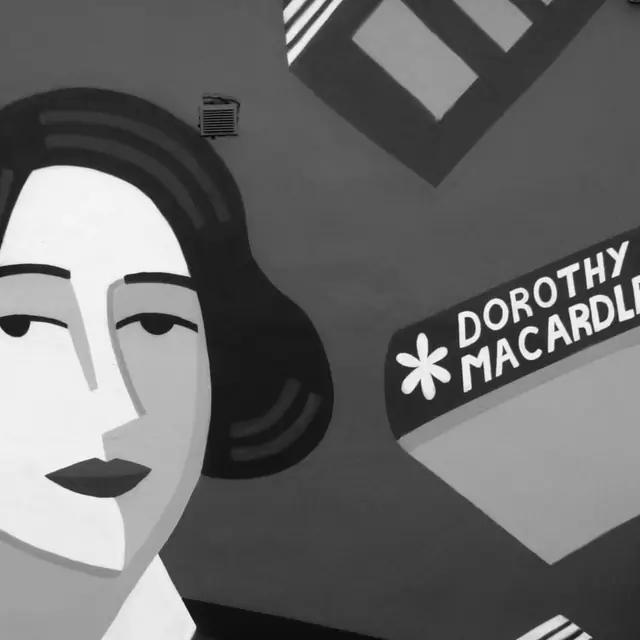
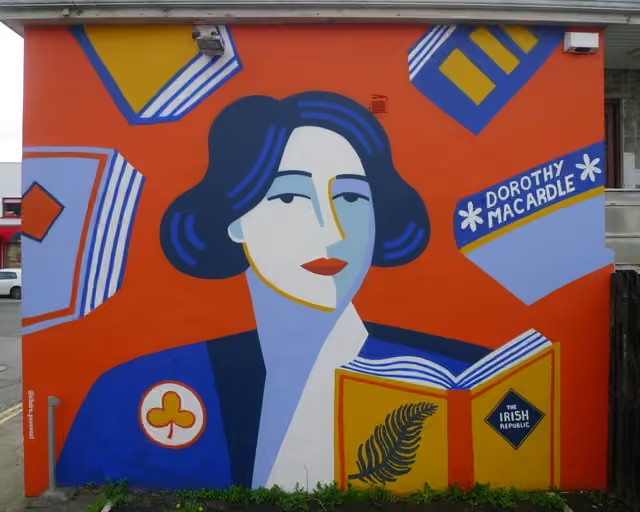
Her independence of mind extended beyond party loyalties. She opposed restrictions on women in the 1937 Constitution and later wrote about children displaced by war in Europe. Her fiction also reached cinema: The Uninvited was adapted for the screen in 1944. Claire Prouvost’s mural can be read against this unusually wide intellectual and humanitarian life.
The full story of Dorothy Macardle IN PUBLISHED WORDS / 1937The Irish RepublicDorothy MacardleA major historical work with a particular political perspective; see the biography for context and her wider bibliography.
Learn moreLearn more about the subject 2
- Dorothy Margaret Macardle: life and writing Royal Irish Academy · Dictionary of Irish Biography
- Dorothy Macardle: fiction bibliography Swan River Press
Historical context and editorial interpretation are distinguished above. Sources researched October 2026.
The story behind the wall.
"A propagandist, unrepentant and unashamed" is how Dorothy Macardle described herself.
She was a revolutionary, humanitarian, and propagandist. She was also a teacher, author, poet, playwright and journalist.
Born in Dundalk in 1889, Dorothy came from a very privileged background. Her father was Thomas Callan Macardle of the Macardle Moore Brewing family, and her mother Minni Hicks came from a distinguished military family. Thomas was a Catholic and an active Home Ruler, while her mother, quite the opposite, was an English Protestant from an imperialist background. On her marriage Minni converted to Catholicism and they went on to have five children, the family lived at 5 Seatown Place.
As the years went by the family split along political lines with Dorothy’s brother Kenneth fighting and dying at the Battle of the Somme in 1916, while she went on to become an ardent supporter of Irish independence, influenced by her father’s ideals.
Dorothy moved to Dublin in her teens, and at her own insistence, attended the prestigious boarding school of Alexandra College. Here she attained a BA Honours degree in English and went on to become a teacher, which was unusual for someone from her wealthy background. She also began writing poetry and producing plays at this time encouraged by her friend W.B. Yeats.
She became politicised after the 1916 Rising and in her own words said ‘before my student days were at an end Ireland possessed my imagination and my heart’. She joined Cumann na mBan and described herself as a ‘teacher by day and rebel by night’. She investigated and reported incidents and atrocities committed and was also a propagandist for Sinn Fein.
During 1922 she spent time in both Mountjoy and Kilmainham jails because of her activism. She also began work on her famous book The Irish Republic around this time. President Eamon de Valera described her book as the most authoritative account of the period from 1916 – 1926. She also wrote articles on the plight of the poor and the failure of Irish Governments to support and legislate properly for women’s rights.
During WW2 the anti-fascist Dorothy worked for the BBC promoting the war effort and she also drove ambulances during the London blitz. After the war Dorothy travelled around Europe documenting the plight of displaced children and her book ‘Children of Europe’ was used extensively by the United Nations. In 1948 Dorothy was one of the founder members of the Irish Association of Civil Liberties.
Despite a lifetime of ill health Dorothy continued to write, often under the pseudonym Margaret Callan, right up until her death. She passed away in Our Lady of Lourdes Hospital Drogheda in 1958.
At her funeral President de Valera said of her ‘Dorothy Macardle was the noble valiant woman of her time, an active champion of every cause that seemed to her good. I have never met anyone so intellectually honest’.
Meet Claire Prouvost.
View artist profile & all their workClaire Prouvost is a French illustrator, painter, graphic designer and street artist based in Dublin, Ireland.
Known for her drawings of charismatic women in a bold, pop and minimalist style, she draws inspiration from fashion photos from the 1970s imbued with lightness and primary colours, alongside hints of Picasso and other cubist artists.
Her eye-catching characters are a playful and colourful combination of shapes and textured contrasts, brightening the environment they are in.